· Shannon Alliance · AI & Data · 6 min read
Is Your Lab Data AI-Ready?
A practical checklist for life science teams. Most AI projects stall not because the models are wrong, but because the data is unfindable.
Most life science companies we talk to want to “do AI.” Many have already bought an enterprise AI assistant. Far fewer can answer a simpler question: where is our data, and can anything other than a person find it?
If you’re a growing team, you may not have a data platform group. A common pattern is a LIMS or an ELN, a few instruments writing files to a network drive, some sensor or device telemetry, and spreadsheets on laptops. That isn’t a failure. It’s what happens when a lab is focused on science. But it does mean AI tools will see very little of what you know.
Why “AI-ready” is a data problem
Modern AI models are effective at reading, summarizing, and reasoning over information. They struggle to find information that’s buried in a folder called Final_v3_JM_USE_THIS, or that only makes sense if you know which plate map goes with which export.
“AI-ready” data has three properties:
- Findable. You know it exists and where it is.
- Connected. Raw files link to the records that give them meaning: sample, experiment, batch, customer, device.
- Governed. You know who can see it, which copy is the record of truth, and what happened to it.
Most of the work is in the second property. It’s also where small teams get the biggest payoff.
The checklist
For each item below, answer honestly: yes, partly, or no.
Inventory and discoverability
Do you have a current list of where your data lives? Not a policy saying where it should live, but a list of where it does live: drives, laptops, instrument PCs, cloud buckets, LIMS, ELN, SharePoint or Google Drive.
Can you find all the data for one sample in under an hour? Pick a real sample ID and time it. If you have to ask three people, that’s your answer.
Do you know how much important data lives only on laptops or instrument PCs? This is the riskiest dark data you have. It’s often unbacked-up and leaves when people do.
Do you know your volumes and growth by source? “About 40 TB, mostly imaging, growing 15 TB a year” is enough. Without it, every architecture conversation is guesswork.
Storage and architecture
Is there one place where analysis-ready data lives? A warehouse, a lakehouse, or even a well-structured search index. Not a dozen project folders.
Do instrument, ELN/LIMS, and sensor data move there automatically? If moving data depends on someone remembering to copy it, it’ll be incomplete.
Do you own and control the cloud account it runs in? Your platform should sit in your AWS, Azure, or GCP account, in open formats, so you’re not locked into a vendor or a consultant.
Metadata and linkage
This is where most of the value is, and where most teams have the biggest gap.
Are file and folder naming conventions consistent and followed? Conventions on a wiki page that nobody follows don’t count.
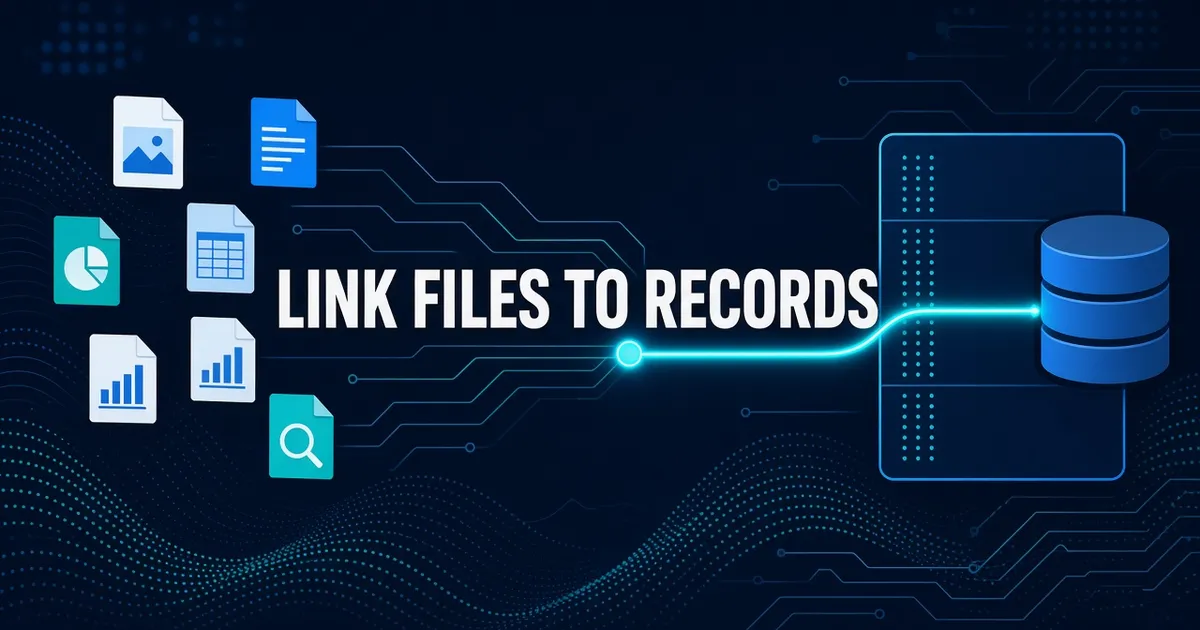
Can raw files be linked to LIMS or ELN records systematically? Not “Sarah knows,” but with the link stored somewhere a query can use.
Is technical metadata extracted and searchable? Instrument settings, stain, assay type, units, firmware version. It’s often already inside the files, in headers, and nobody has pulled it out.
Do your systems share identifiers? Sample, study, lot, device, and customer IDs that match across systems.
A concrete example
A digital pathology company had about 1 PB of SVS and BigTIFF slide images on a network drive. Every image carried useful metadata in its header, and every storage path encoded useful context. But nobody could search across them.
We parsed the headers and paths, linked each slide to its LIMS record, and indexed everything in AWS OpenSearch. Now staff can search slides by stain, tissue type, or customer.
The company had been quoted a $50,000 license for software that would still have needed the same engineering. The solution we built costs under $1,000 a year to run, and they own it.
The lesson isn’t “build everything yourself.” It’s that linkage is the core work, and a software license alone won’t do it for you.
Quality and governance
Does each important data source have a named owner? One person who can answer “is this right?”
Do you check data before it’s used? Even basic automated checks—row counts, required fields, valid IDs—catch most problems.
For GxP data, is it clear which system is the record of truth and how copies are controlled? AI and analytics should read controlled copies, not modify the record of truth.
Security and access
Do people sign in with SSO? Shared accounts and local passwords are a blocker for any AI connection.
Is access to sensitive data role-based and reviewed? Customer, partner, and patient data, and your own IP.
Can you produce an audit trail of who accessed key data? Ideally from one place you can query.
AI use and connection
Is your enterprise AI assistant deployed with SSO and audit logging switched on?
How does it reach internal data today? If the answer is “people upload files,” you have no audit trail and the answers go stale.
Have you decided what AI may and may not access, and for which uses? Write it down, and enforce it with read-only access to curated data rather than raw systems.
How to read your results
Count your answers.
Mostly “no”: You have dark data. Start with an inventory. A metadata-only scan of your top three file shares will tell you more in a week than a year of meetings.
Mixed: You’re emerging. You have pieces, and linkage and governance are the gaps. Pick one high-value domain—one assay, one product line, one trial program—and connect it end to end.
Mostly “yes”: You’re connected or AI-ready. The work now is exposing curated data safely to the AI tools your team already uses, and scaling to more domains.
A typical starting point
Here’s a situation we see frequently in the teams we work with. An R&D team uses an ELN for experiment records. But trial data, plate-reader exports, and field results live on laptops and shared drives, and there’s no database, lake, or warehouse. The ELN knows what was done. The files hold what happened. Nothing joins them.
The fix isn’t a big platform program. It’s three steps:
- Inventory what exists, by metadata only.
- Land one trial program in a lakehouse in the team’s own cloud account, keyed to ELN experiment IDs.
- Make it searchable, and connect it to the team’s AI assistant through a read-only, logged connection.
That’s weeks of work, not quarters.
What to do next
If this checklist raised more questions than it answered, that’s normal. In our experience, many growing teams have never had anyone look at their data end to end.
We offer a full AI Data Readiness Assessment: in 1–2 weeks you get a data inventory, a readiness score, a target architecture for your cloud, and a prioritized 90-day roadmap.